
DOCTORS AGAINST ANIMAL RESEARCH
on medical and scientific grounds.
For most recent version of this article see http://www.MedicineKillsMillions.com
We've all been raised to believe that animal research is scientific and apparently responsible for medical progress. However, there are many doctors and medical researchers that explain otherwise. You will rarely see or hear the views of these scientists in the mass-media because they directly threaten the profits of one of the largest sources of media advertising revenue ie. the pharmaceutical/chemical industries. The mass-media rarely publishes information that threatens the interests of their advertisers. The reference for these quotes is further below.

"The reason why I am against animal research is because it doesn't work, it has no scientific value and every good scientist knows that."
Dr. Robert Mendelsohn, M.D., 1986, Head of the Liscensing Board for the State of Illinois, paediatrician & gynaecologist for 30 years, medical columnist & best-selling author, recipient of numerous awards for excellence in medicine.
"Since there is no way to defend the use of animal model systems in plain English or with scientific facts, they resort to double-talk in technical jargon...The virtue of animal model systems to those in hot pursuit of the federal dollar is that they can be used to prove anything--no matter how foolish, or false, or dangerous this might be. There is such a wide variation in the results of animal model systems that there is always some system which will "prove" a point....The moral is that animal model systems not only kill animals, they also kill humans. There is no good factual evidence to show that the use of animals in cancer research has led to the prevention or cure of a single human cancer."
Dr. D.J. Bross, Ph.D., 1982, former director of the largest cancer research institute in the world, the Sloan-Kettering Institute, then Director of Biostatics, Roswell Memorial Institute, Bufallo, NY.
"Practically all animal experiments are untenable on a statistical scientific basis, for they possess no scientific validity or reliability. They merely perform an alibi for pharmaceutical companies, who hope to protect themselves thereby."
Herbert Stiller, M.D. & Margot Stiller M.D., 1976.
"Like every member of my profession, I was brought up in the belief that almost every important fact in physiology had been obtained by vivisection and that many of our most valued means of saving life and diminishing suffering had resulted from experiments on the lower animals. I now know that nothing of the sort is true concerning the art of surgery: and not only do I not believe that vivisection has helped the surgeon one bit, but I know that it has often led him astray."
Prof. Lawson Tait, M.D., 1899, Fellow of the Royal College of Surgeons (F.R.C.S.), Edinburgh & England. Hailed as the most distinguished surgeon of his day, the originator of many of surgery's modern techniques, and recipient of numerous awards for medical excellence.
"Vivisection is barbaric, useless, and a hindrance to scientific progress. I learned how to operate from other surgeons. It's the only way, and every good surgeon knows that."
Dr. Werner Hartinger, 1988, surgeon of thirty years, President of German League of Doctors against Vivisection (GLDAV)

"Atrocious medical experiments are being done on children, mostly physically and handicapped ones, and on aborted foetuses, given or sold to laboratories for experimental purposes. This is a logical development of the practice of vivisection. It is our urgent task to accelerate its inevitable downfall."
Prof. Pietro Croce, M.D., 1988, internationally renowned researcher, former vivisector.
"Normally, animal experiments not only fail to contribute to the safety of medications, but they even have the opposite effect."
Prof. Dr. Kurt Fickentscher, 1980, of the Pharmacological Institute of the University of Bonn, Germany.
"Experiments on animals lead inevitably to experiments on people...As if an animal experiment could ever predict the same result on a person. And as if an experiment on one human being could enable us to foresee the reactions of another human being, whose biology and metabolism are different, whose blood pressure is different, whose lifestyle and age and nourishment and sensitivity and genes and everything else are different...We recognise that each single organism, whether human or animal, has its very own reactions...Today's orthodox medicine and suppressive surgery don't understand the purpose of disease and therefore don't know how to treat it. A real doctor's experience derives from his natural intuition coupled with his observation at the sickbed, but never from invasive, violent experiments on people, and much less on animals. Instead of vital hygiene, which aims at preservation or reconstruction of health by natural means and shuns all use of degrading, destructive chemicals, today"s medical students are only taught to manipulate poisons and mutilate bodies. We demand that this be changed."
Prof. Andre Passebecq, M.D., N.D., D.Psyc., 1989, Faculty of Medicine of Paris, then President of the International League of Doctors Against Vivisection.
"Giving cancer to laboratory animals has not and will not help us to understand the disease or to treat those persons suffering from it."
Dr. A. Sabin, 1986, developer of the oral polio vaccine.
"Not only are the studies themselves often lacking even face value, but they also drain badly needed funds away from patient care needs."
Dr. Neal Barnard, M.D., 1987, President of the Physicians Committee for Responsible Medicine (PCRM), Washington.
"All our current knowledge of medicine and surgery derives from observations of man following especially the anatomical-clinical method introduced by Virchow: symptoms of the patient while alive and the alterations found in the dead body. These observations have led us to discover the connection between smoking and cancer, between diet and arteriosclerosis, between alcohol and cirrhosis, and so on. Even the RH factor was not discovered on the macasus rhesus. The observations of Banting and Best on diabetes, attributed to experiments on dogs, were already well-known.
Every discovery derives from observations on humans, which are subsequently duplicated in animals, and whenever the findings happen to concur, their discovery is attributed to animal experimentation. Everything we know today in medicine derives from observations made on human beings. The ancient Romans and Greeks gained most of their knowledge from epidemiological studies of people.
The same goes for surgery. Surgery can't be learned on animals. Animals are anatomically completely different from man, their reactivity is completely different, their structure and resistance are completely different. In fact, exercises on animals are misleading. The surgeon who works a lot on animals loses the sensibility necessary for operating on humans."
Prof. Bruno Fedi, M.D., 1986, Director of the City Hospital of Terni, Italy, anatomist, pathologist, specialist in urology, gynaecology and cancerology.
"My own conviction is that the study of human physiology by way of experimenting on animals is the most grotesque and fantastic error ever committed in the whole range of human intellectual activity."
Dr. G.F. Walker, 1933.
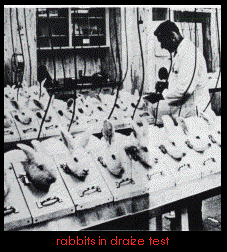
"Why am I against vivisection? The most important reason is because it's bad science, producing a lot of misleading and confusing data which pose hazards to human health. It's also a waste of taxpayer's dollars to take healthy animals and artificially and violently induce diseases in them that they normally wouldn't get, or which occur in different form, when we already have the sick people who can be studied while they're being treated."
Dr. Roy Kupsinel, M.D., 1988, medical magazine editor, USA.
"It is well known that animal effects are often totally different from the effects on people. This applies to substances in medical use as well as substances such as 245y and dioxin."
Dr. A.L.Cowan, M.D., 1985, Acting Medical Officer of Health, New Plymouth, N. Z.
"The growing opposition to vivisection is understandable both on ethical and biological counts. However, a certain scientistic culture says they serve to save human lives. But reality is quite the opposite. Let"s take the case of pesticides. These dangerous products, used in agriculture, are classified according to their acute toxicity, graduated with the Lethal Dose 50% tests on animals. This represents not only a useless sacrifice of animals, but it"s an alibi that enables the chemical industry to sell products which are classified as harmless or almost harmless, but are in reality very harmful in the long run, even if taken in small doses. Many pesticides classified as belonging to the fourth category, meaning they can be sold and used freely, have turned out to be carcinogenic or mutagenic or capable of harming the fetus. Also in this case, animal tests are not only ambiguous, but they serve to put on the market products of which any carcinogenic effect will be ascertained only when used by human beings--the real guinea-pigs of the multinationals. And yet there are laboratory tests that can be used, which are cheaper and quicker than animal tests; in vitro tests on cell cultures, which have been proving their worth for years already. But the interests of the chemical industries which foist on us new products in all fields may not be questioned."
Prof. Gianni Tamino, 1987, biologist at Padua University, a Congressman in the Italian Parliament.
"Animal model systems differ from their human counterparts. Conclusions drawn from animal research, when applied to human beings, are likely to delay progress, mislead, and do harm to the patient. Vivisection, or animal experimentation, should be abolished."
Dr. Moneim Fadali, M.D., 1987, F.A.C.S., Diplomat American Board of Surgery and American Board of Thoracic Surgery, UCLA faculty, Royal College of Surgeons of Cardiology, Canada.
"Experiments have never been the means for discovery; and a survey of what has been attempted of late years in physiology will prove that the opening of living animals has done more to perpetuate error than to confirm the just views taken from the study of anatomy and natural motions."
Sir Charles Bell, M.D., 1824, F.R.C.S., discoverer of "Bell's Law" on motor and sensory nerves.
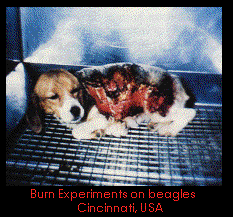
"Experiments on animals do not only mean torture and death for the animals, they also mean the killing of people. Vivisection is a double-edged sword."
Major R.F.E.Austin, M.D.,1927, Royal College of Surgeons, Licentiate of the Royal College of Physicians.
Cawadias (1953) has said that:
"The history of medicine has shown that, whenever medicine has strayed from clinical observation, the result has been chaos, stagnation and disaster."
(British Medical Journal, 8/10/1955).
For more statements by doctors against animal experimentation
see the article
The International Congress
Of Doctors Against Vivisection and more articles available via
the medical/health index page.
Reference:
The above quotes are taken from the book, "1000 Doctors (& many more) Against Vivisection", (Ed. Hans Ruesch), CIVIS, Switzerland, 1989. 288 pages.
It is available from:
Australia - The
Campaign Against Fraudulent Medical Research (CAFMR) for $21:50
Aust.;
Europe - Europe -
Doctors & Lawyers for
Responsible Medicine (DLRM): 104b Weston Park, London N8 9PP,
UK. and
USA - $16 US from The
Nature of Wellness.
Recommended Organisations:
-
Doctors and Lawyers for Responsible Medicine: British based group with over 500 professional members. Their objective is the immediate and unconditional abolition of all animal experiments, on medical and scientific grounds. http://www.dlrm.org/
-
Nature of Wellness - a large USA organisation that is dedicated to exposing the scientific fraud of animal research as well as promoting truly scientific (ie. non-vivisectionist) methods of medical research and human health care. Some terrific videos available such as "Lethal Medicine". http://www.animalresearch.org
-
Guardians - a group that challenges animal research on medical grounds. Many many great articles by doctors, scientists and lay persons exposing the medical myths of the pharmaceutical and animal research lobby; explaining why animal research is extremely dangerous to human health. http://home.mira.net/~antiviv/
-
Campaign Against Fraudulent Medical Research (CAFMR): Lots of great information that the pharmaceutical-chemical industry and their mass media do not want us to know. http://www.pnc.com.au/~cafmr
-
British Anti-Vivisection Association - a trustworthy British organisation. The above article was obtained from their website. http://www.bava.pwp.blueyonder.co.uk/
CONFORM!
Join the News List:
To join the EYE & Blatant Propaganda e-mail list, please enter your details below. At present we send news once every month or so.